Best Smart Garage Doors United States: Architectural Automation and Ecosystem Guide
Residential entry points across the United States represent both the largest moving structural barriers and active digital nodes within modern smart homes. Traditional overhead portals relied strictly on local radio frequency transmitters to cycle door panels up and down. Best Smart Garage Doors United States. Today, connected access platforms integrate cloud microservices, local area networks, edge computer processing, and real-time monitoring sensors.
Evaluating automated portals requires moving beyond basic convenience claims. A connected garage system must execute heavy physical movement while maintaining strict digital perimeter security. When an automated opener joins a residential network, cyber threats merge with traditional mechanical wear vectors. Unencrypted wireless protocols or poorly designed cloud APIs can expose physical living quarters to unauthorized entry.
Designing a reliable access framework requires balancing mechanical lift capacity, sensor precision, local network stability, and motor drive efficiency. Homeowners and building specifiers must evaluate motor types, automatic track deadbolts, local home automation protocols, and remote management controls simultaneously. Achieving complete operational reliability demands evaluating how physical hardware, network connectivity, and cloud software perform together under real-world conditions.
Best Smart Garage Doors United States
Scope of Connected Access Architecture
Evaluating the best smart garage doors united states involves analyzing physical drive hardware alongside digital communication protocols. The phrase refers to analyzing complete overhead access platforms engineered to execute automated physical operation while providing real-time digital perimeter monitoring across American housing markets.
Evaluating connected portals requires looking beyond basic smartphone application controls. Physical structural mass, motor drive efficiency, emergency power backups, and automated track locking mechanisms define baseline physical safety.
Common Misconceptions in Portal Evaluation
A frequent misunderstanding involves equating add-on retrofitted sensor tilt units with fully integrated smart opener systems. Universal Wi-Fi sensor relays report door position using basic gravity tilt switches, but these add-on devices cannot manage motor speed curves or detect mechanical track obstructions.
Another common error involves assuming all smart platforms support local home automation natively. Many commercial smart opener platforms rely entirely on proprietary cloud servers to execute remote commands. When internet service interruptions occur, remote phone access drops completely unless local control protocols remain active.
Risks of Architectural Oversimplification
Focusing exclusively on digital app features while ignoring mechanical lift capacity creates severe operational risks. Installing a high-tech smart opener on heavy 20-gauge steel panels with undersized DC motors causes thermal motor shut-offs during peak summer temperatures.
Similarly, pairing advanced digital access systems with worn torsion springs leads to mechanical failure. Heavy doors strain lifting gears, causing plastic drive teeth to strip over time. Smart automation planning must combine solid mechanical lifting components with reliable digital control networks.
Evolution of Smart Entry Engineering in North America
The Transition from Fixed Radio Codes to Rolling Encryption
Early residential automated openers created in the late 20th century utilized simple dip-switch radio frequency controls. These early remote controls transmitted fixed binary codes across open airwaves, allowing unauthorized users to capture signals using basic radio scanners.
Engineers resolved signal interception risks by developing dynamic rolling-code encryption systems. Modern smart openers utilize bi-directional wireless protocols that authenticate digital credentials continuously, stopping code replay attacks completely.
Technological Advancement in Connected Automation
The introduction of residential Wi-Fi chipsets and mobile operating systems fundamentally altered access control design. Modern smart openers integrate onboard camera optics, automated track deadbolts, and multi-ecosystem integration hubs.
Current platforms process automated routines locally using Bluetooth, Zigbee, Z-Wave, or Matter communication protocols. Direct local mesh processing keeps smart garage doors operational even during major cloud network outages.
Conceptual Frameworks for Cyber-Physical Access Evaluation
Network Dependency and Latency Matrix
Evaluating smart access platforms requires structured analytical models. The Network Dependency Matrix evaluates control platforms across three digital operational layers:
System Operational Layers
-
Local Mechanical Layer: Direct physical switches, hardwired wall stations, and manual emergency release levers.
-
Local Wireless Layer: Bluetooth Low Energy and Z-Wave mesh protocols operating directly without internet routing.
-
Cloud API Layer: Vendor cloud microservices facilitating remote mobile access, voice assistant commands, and third-party integrations.
Applying this analytical model highlights operational dependencies, ensuring critical access functions remain active during network disruptions.
Cyber-Physical Threat Vector Framework
This analytical framework evaluates systemic access vulnerabilities by mapping physical door mechanics against digital entry points. Dynamic motor strain, track deadbolt engagement, wireless signal interception, and cloud account credentials are evaluated together to prevent isolated structural failures.
Primary Smart Access Categories and Drive Hardware
Integrated Smart Belt-Drive Systems
Integrated smart belt-drive openers combine quiet mechanical lifting with built-in Wi-Fi and Bluetooth communication modules. Rubber-reinforced steel belts deliver smooth, silent panel movement, making them ideal for garages beneath bedrooms.
Directly integrated openers feature factory-installed optical sensors, battery backup systems, and automatic track deadbolts. Internal control boards manage soft start and soft stop motor cycles, reducing physical strain on door panel hinges.
Heavy-Duty Direct-Drive Wall-Mount Platforms
Direct-drive wall-mount platforms mount directly to structural wall jambs beside torsion spring shafts. These compact units eliminate overhead rail assemblies entirely, clearing ceiling space for overhead storage or high-lift vehicle tracks.
Wall-mount systems include automatic cable tension sensors and heavy motorized track deadbolts. These systems handle heavy structural steel and solid wood custom carriage doors efficiently.
Retrofit Smart Controller Modules
Retrofit smart controller modules convert traditional overhead openers into connected access nodes. These add-on kits attach external control relays to existing opener wall button terminals.
External tilt or optical sensors mounted on top door panels report physical open or closed status to mobile applications. Retrofit modules provide affordable smart connectivity, though they cannot monitor motor health or track internal mechanical errors.
Architectural System Architecture Matrix
Evaluating smart access platforms requires analyzing structural parameters directly across operational metrics.
| System Platform Category | Drive Mechanism Type | Primary Wireless Protocols | Local Hub Processing | Integrated Deadbolt Sync | Battery Backup Support |
| Integrated Smart Belt-Drive | Steel-Reinforced Rubber Belt | Wi-Fi / Bluetooth / Prop. RF | Optional | Native Automatic | Integrated Li-ion/Lead-Acid |
| Wall-Mount Direct-Drive | Direct Shaft Coupling | Wi-Fi / Bluetooth / Z-Wave | Native Local | Native Automatic | Integrated Backup |
| Smart Chain-Drive Hub | Heavy Steel Roller Chain | Wi-Fi / Proprietary RF | Cloud Dependent | External Accessory | Optional External |
| Retrofit Controller Kit | External Relay Module | Wi-Fi / Bluetooth / Zigbee | Varies by Hub | Manual External | Not Available |
| Commercial Heavy Duty | Direct Gear Drive | Ethernet / Wi-Fi / RS-485 | Full Local Control | Commercial Lock | External UPS System |
Mechanical Drive Kinetics and Emergency Battery Infrastructure
DC Motor Efficiency and Soft Start Kinetics
Modern high-performance smart openers utilize Direct Current (DC) motors rather than traditional Alternating Current (AC) induction drives. DC motors deliver high torque output within small physical housing dimensions, allowing precise speed management.
Variable speed motor controllers execute soft start and soft stop motion profiles. Slowing panel movement near full open and closed positions reduces dynamic shock loads on track rollers, hinges, and counterbalance springs.
Emergency Battery Backup Architecture
Electric power outages isolate unequipped automated doors, requiring manual emergency release cord operation. High-grade smart openers include integrated 12V or 24V battery backup systems to maintain full motorized operation.
Building codes in high-risk climate regions mandate battery backup integration on all newly installed residential openers. Integrated battery systems power motor drives, safety light sensors, and automated track deadbolts during multi-day power failures.
Real-World Residential Integration Scenarios Best Smart Garage Doors United States
High-Density Urban Smart Homes
Urban residences with attached multi-car garages face constant local Wi-Fi channel congestion from neighboring networks. High network noise causes cloud-dependent smart openers to drop connection frequently.
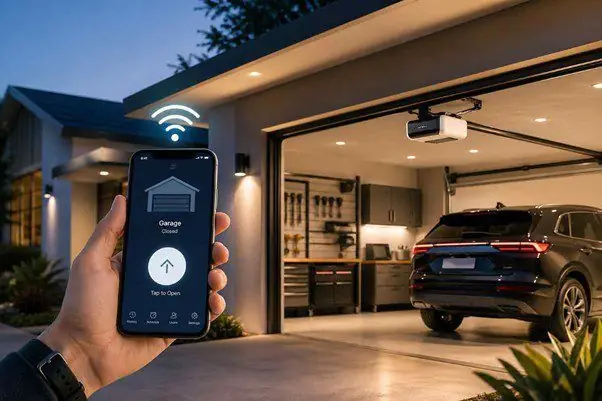
Urban smart installations require local mesh protocols like Z-Wave or local Ethernet wiring. Hardwired network connections eliminate wireless signal interference, guaranteeing fast mobile notification responses.
Rural Compound Integration
Rural properties featuring detached shop buildings located far from main residences present severe range challenges for standard Wi-Fi openers. High physical distance causes frequent app connection drops.
Detached building setups require long-range point-to-point wireless bridges or sub-GHz mesh protocols. Local automation hubs handle access routines locally, opening doors automatically as authorized vehicles approach compound gates.
Financial Dynamics, Subscription Models, and Ownership Costs
Upgrading to connected smart garage systems requires evaluating upfront hardware purchases alongside ongoing cloud software fees. The table below outlines investment ranges across smart access categories.
| Platform Tier | Motor & Connectivity Specs | Lock & Safety Systems | Est. Hardware & Install Cost ($) | Cloud Subscription Model |
| Retrofit Kit | External Wi-Fi Relay Module | Basic Wireless Tilt Sensor | $80 – $180 | Free Basic / Paid Video |
| Mid-Tier Belt-Drive | DC Belt Motor w/ Built-In Wi-Fi | Safety Photo-Eyes | $350 – $650 | Free Basic / Tiered Storage |
| High-End Direct-Drive | Direct Shaft Mount / Wi-Fi / Z-Wave | Automatic Track Deadbolt | $750 – $1,350 | Free Local / Optional Cloud |
| Custom Architectural | Commercial-Grade DC / Multi-Protocol | Dual Deadbolts + Camera Hub | $1,500 – $3,200+ | Enterprise / Custom Hub |
Evaluating total ownership costs requires checking whether smart features require monthly platform subscription fees. Free local processing offers lower total ownership costs than proprietary cloud services over ten-year operating periods.
Network Protocols, Local Processing, and Cloud Dependencies
Local Protocols versus Proprietary Cloud API Networks
Evaluating connected openers highlights a clear structural divide between local mesh protocols and vendor-managed cloud ecosystems. Local protocols process automation commands directly inside residential networks without sending data over external internet servers.
Vendor cloud platforms route every mobile app command through remote servers. While cloud microservices enable remote monitoring from anywhere, server maintenance or home internet outages disable remote door operations completely.
The Role of Unified Smart Home Standards
Unified smart home communication standards simplify cross-brand automation integration. Open communication frameworks allow smart openers to connect directly with regional security hubs, lighting networks, and HVAC controllers.
Unified standards eliminate proprietary API bridges, reducing network setup complexity while ensuring long-term operational compatibility across diverse smart home hardware.
Cyber-Physical Threat Landscapes and Perimeter Defense
Unencrypted Wireless Interception and Replay Attacks
Legacy wireless openers using static radio frequencies remain vulnerable to cheap signal capture devices. Intruders capture unencrypted signals from afar and replay them to open garage doors silently. Modern smart platforms eliminate signal replay risks by utilizing AES-128 or AES-256 encrypted rolling-code wireless protocols.
Additional security risks include cloud account credential theft, where weak passwords allow remote open commands, and physical emergency cord fishing, where tools reach past top door seals to release motor trolleys.
Cloud Microservice Outages and API Invalidation
Cloud-dependent smart openers suffer functional loss during vendor server outages or sudden API shifts. If a manufacturer alters cloud access protocols without updating third-party integrations, automated routines fail immediately. System designs should prioritize local controller fallback modes to preserve mobile access during cloud downtime.
Operational Governance and Maintenance Protocols Best Smart Garage Doors United States
Preserving connected access performance demands routine hardware maintenance and timely digital software updates.
Integrated Maintenance Checklist
-
Quarterly Safety Reversal Test: Place a 1.5-inch wooden block under bottom door panels; verify motor reverses instantly upon contact.
-
Bi-Annual Battery Health Check: Unplug main AC power supply; test opener motor operation using internal battery backup power.
-
Semi-Annual Firmware Audits: Verify smart opener firmware updates install automatically to patch network security vulnerabilities.
-
Annual Sensor Track Realignment: Clean optical lens covers and measure side track photo-eye alignment to prevent false reversal triggers.
Proactive maintenance prevents mechanical binding and stops network communication failures before operational breakdowns occur.
Leading Metrics and Network Diagnostic Signals
Evaluating system health requires tracking both mechanical lift signals and digital network metrics.
Leading vs. Lagging Performance Indicators
Leading indicators highlight emerging mechanical or digital issues before system failure occurs. Minor motor noise changes, Wi-Fi signal drops, and slight travel speed delays point to mechanical drag or network interference.
Lagging indicators document access failures after breakdown events happen. Thermal motor trip fault logs, completely uncalibrated travel limits, and failed automated lock engagements show system hardware operated past safe limits. Tracking these signals allows homeowners to schedule preventive maintenance before complete system failure occurs.
Common Planning Misconceptions and Technical Oversimplifications
Myth 1: Smartphone Control Eliminates Physical Lock Needs
Many homeowners assume installing a smart opener eliminates the need for physical deadbolt locks. Standard opener trolley arms resist manual lifting slightly, but heavy pry tools can still force unlocked panel tops open. Complete perimeter security requires pairing smart openers with synchronized automatic track deadbolts.
Myth 2: High Wi-Fi Signal Strength Guarantees Reliability
Assuming strong Wi-Fi signals guarantee reliable opener performance is a common oversimplification. High Wi-Fi signal strength cannot prevent connection drops caused by local router channel congestion or cloud server latency. Reliable automation relies on low-latency local processing rather than simple signal strength metrics.
Strategic Synthesis for Connected Residential Envelopes
Evaluating the best smart garage doors united states requires balancing heavy mechanical lifting hardware, robust digital encryption, and reliable local network protocols. Evaluating connected access portals as complete cyber-physical systems ensures long-term home security and dependable daily operation.
System Specification Verification Checklist
-
[ ] Mechanical Lifting Capacity: Match DC motor torque ratings to structural door panel weight precisely.
-
[ ] Backup Power Systems: Confirm openers include integrated battery backups compliant with safety standards.
-
[ ] Physical Security Locks: Install automatic track deadbolts synchronized with opener motor cycles.
-
[ ] Network Protocol Selection: Choose platforms supporting local control protocols to avoid cloud-only dependencies.
-
[ ] Safety Sensor Coverage: Verify multi-ray optical safety eyes mount securely along side tracks.
-
[ ] Cyber Security Hygiene: Use strong account passwords and enable two-factor authentication on all access apps.
Systematic planning, professional installation, and routine maintenance convert large garage openings into safe, highly reliable smart access nodes for modern connected American homes.